


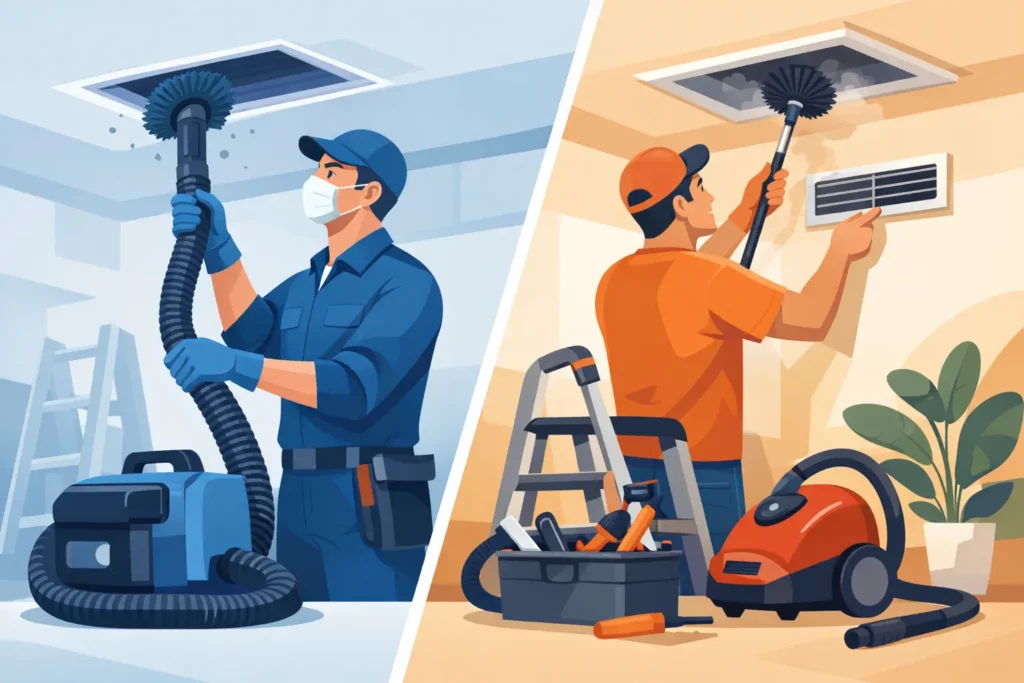
You pull a vent cover, see a layer of dust, and think, how hard can this be? That is exactly where the professional duct cleaning vs diy decision starts. For many homeowners, condo residents, and property managers, the question is not whether dust exists in the system. It is whether a shop vacuum and a free afternoon can solve the real problem.
Sometimes, a little DIY cleaning helps. Often, it only cleans the part you can see and leaves the deeper buildup untouched. That difference matters because ducts affect airflow, dust circulation, and how your HVAC system performs day after day.
Professional duct cleaning vs DIY: what is the real difference?
DIY duct cleaning usually means removing a few vent covers, vacuuming around the openings, wiping visible dust, and maybe using a household brush attachment to reach a little farther into the duct line. That can improve the appearance of registers and remove loose debris near the surface.
Professional duct cleaning is a full-system service. It is designed to clean supply and return ductwork, remove settled dust and contaminants from deeper sections, and address components that homeowners usually cannot access properly with household tools. A serious service is not about making vents look cleaner. It is about extracting buildup from the system without spreading it through the home.
That is the biggest gap between the two. DIY is surface-level maintenance. Professional service is system-level cleaning.
When DIY makes sense
Not every duct concern needs a truck, specialized equipment, and a scheduled appointment. If your vent covers are dusty, if you recently noticed pet hair near a register, or if you want to do some routine upkeep between cleanings, DIY can be perfectly reasonable.
Homeowners can safely handle a few basic tasks. Removing and washing vent covers helps. Vacuuming just inside the register opening helps too. Changing HVAC filters on schedule is one of the best things you can do for indoor air and system performance. Keeping the area around vents clean also reduces how much dust gets pulled into returns.
For newer homes with no renovation debris, no unusual odors, and no signs of airflow issues, light DIY upkeep may be enough for the moment. The key is being honest about what you are actually cleaning. If you are only reaching the first foot or two of ductwork, you are not cleaning the whole system.
Where DIY falls short fast
Duct systems are longer, more complex, and more fragile than they look from the vent opening. Bends, branch lines, sealed joints, returns, and internal components all create places where dust can settle out of sight. Household vacuums are not built to create the negative pressure needed to pull heavy debris from deep inside the system.
There is also the risk of making the problem worse. A brush that is too stiff can damage flexible ducting. An aggressive vacuum hose can dislodge material without actually removing it, which can push debris farther into the system or send it back into your living space. In older homes or poorly maintained buildings, disturbing buildup without the right containment can create a mess instead of a solution.
This is where people get frustrated. They spend time cleaning vents, but the home still feels dusty. Rooms still have uneven airflow. The HVAC system still smells stale when it starts up. That usually means the visible dust was not the real issue.
What professionals do that DIY cannot
A legitimate duct cleaning team uses specialized equipment designed for source removal. That means contaminants are loosened and extracted, not just stirred around. The process typically includes high-powered vacuum collection, agitation tools that reach deep into duct lines, and cleaning methods suited to the type of ductwork in the property.
A professional also looks beyond the grille. They assess the condition of the system, identify problem areas, and spot signs that point to other issues, like excess dust from leaks, construction debris, restricted airflow, or buildup that suggests overdue maintenance. In multi-unit buildings and commercial spaces, this matters even more because the duct layout is more complex and the consequences of poor airflow affect more people.
Good service is also about doing the job cleanly and transparently. You should know what is being cleaned, what is not, and why. That level of clarity separates real air duct specialists from low-price operators who show up with vague promises and leave with your money.
The cost question: cheaper now or smarter later?
DIY almost always looks cheaper upfront. If you already own a vacuum, a screwdriver, and basic cleaning supplies, there is little direct cost. But price alone is the wrong comparison.
The better question is whether DIY will solve the issue you actually have. If your concern is light dust on vent covers, yes, it probably will. If your concern is persistent dust around the home, weak airflow, post-renovation debris, allergy irritation, or stale air from the system, probably not.
When DIY falls short, the hidden cost is time, repeated cleaning, and ongoing HVAC strain. Dirty ductwork can contribute to poor airflow and recirculated dust. If your system is already working harder than it should, surface cleaning does not change much. Paying for proper service once can be more cost-effective than trying partial fixes over and over.
Signs you should skip DIY and call a pro
Some situations are not worth guessing on. If you see heavy debris coming from vents, notice a musty or burnt smell when the HVAC system runs, or just finished a major renovation, professional service is the smarter move. The same applies if certain rooms have weak airflow, if you are dealing with unusual dust buildup despite regular cleaning, or if occupants have respiratory sensitivities and you want a cleaner system, not just cleaner vent covers.
Property managers and landlords should be especially careful here. In rental properties, condos, and mixed-use buildings, a half-measure can create more complaints than confidence. Residents want dependable airflow and cleaner indoor conditions, not cosmetic cleaning around registers.
Dryer vents are another category entirely. Many people treat them like air ducts, but the risk profile is much higher because lint buildup is a fire hazard. Light exterior lint removal is fine, but deeper dryer vent cleaning is one area where professional service is often the safer call.
Professional duct cleaning vs DIY for condos and commercial spaces
In a single-family home, DIY has some limited value because you control the space and can monitor results closely. In condos and commercial properties, the calculation changes.
Condo residents often have limited access to parts of the ventilation system and may not know what belongs to their unit versus the building. Commercial operators and facility managers have a bigger responsibility. Airflow problems affect comfort, cleanliness, and tenant experience. Poor maintenance can also lead to more frequent complaints and reduced HVAC efficiency.
That is why professional service tends to make more sense in shared or larger properties. The system is more complex, the stakes are higher, and the margin for error is lower. You want trained technicians, clear scope, and real equipment.
How to avoid getting fooled by cheap duct cleaning offers
This topic matters because not all professional cleaning is actually professional. The duct cleaning industry has its share of bait-and-switch pricing, rushed work, and scare tactics. If an offer sounds impossibly cheap, it usually is.
A credible company should be clear about pricing, scope, and process. They should explain what is included and answer direct questions without dancing around them. If someone uses pressure, makes dramatic contamination claims without evidence, or refuses to describe their equipment, that is your sign to walk away.
For homeowners in the Greater Toronto Area, this is especially relevant because scam-style duct cleaning calls have been a real issue for years. A trustworthy provider does not need to hide behind vague pricing or aggressive sales tactics. They earn trust by being direct, local, and accountable.
The better answer is not always one side
The truth about professional duct cleaning vs diy is that it is not an all-or-nothing choice. DIY has a place in regular upkeep. Clean the covers. Change filters. Vacuum around registers. Keep return vents unobstructed. Those habits help and they make professional service more effective when it is needed.
But DIY should not be mistaken for full duct cleaning. If your goal is deeper contaminant removal, better airflow, or a cleaner HVAC system after years of buildup, professional service is the stronger option. It is faster, more thorough, and far less likely to leave the real problem behind.
That is the practical way to think about it. Use DIY for maintenance. Use professionals for results. If your air still feels dusty after you have done the basics, your vents are probably telling you something worth taking seriously.