


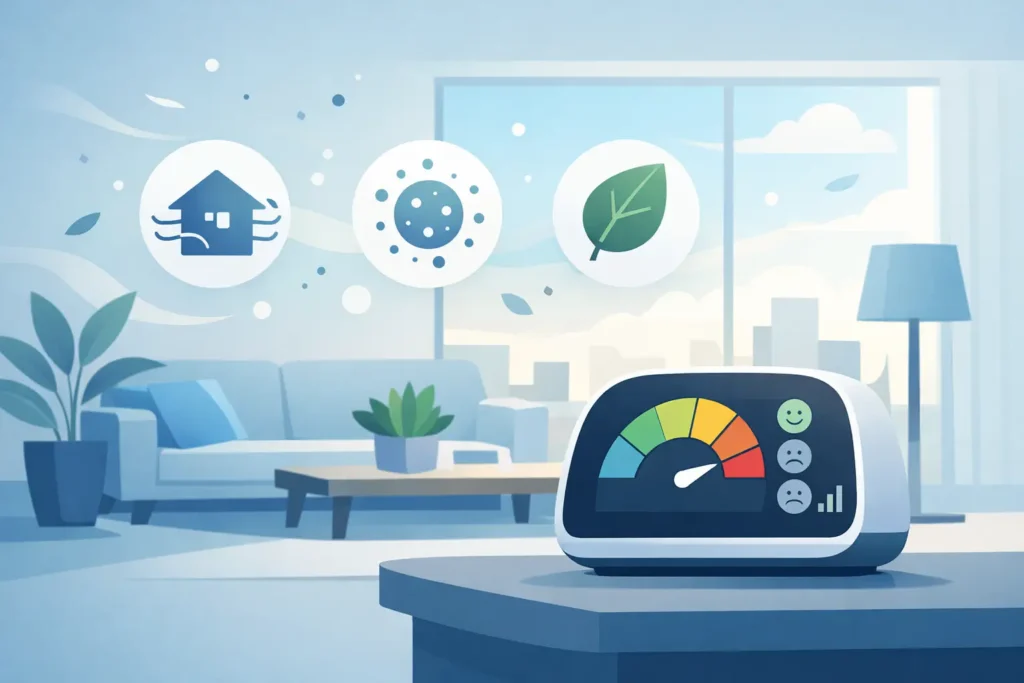
You check an air quality monitor and see a number staring back at you – 12, 650, 42%, maybe 180. The problem is that indoor air quality is not one number. If you are asking what is a good indoor air quality number, the real answer depends on what the device is measuring and how your space actually feels, smells, and breathes.
That matters because plenty of homes, condos, and commercial spaces look clean while the air tells a different story. Dust buildup in ductwork, poor ventilation, clogged filters, excess humidity, and lingering contaminants can all push readings in the wrong direction. A monitor can help, but only if you know which numbers deserve your attention.
What is a good indoor air quality number for a home?
For most indoor spaces, a good indoor air quality number means keeping several readings in healthy ranges rather than chasing one perfect score. The most useful benchmarks are PM2.5, carbon dioxide, humidity, volatile organic compounds, and carbon monoxide.
PM2.5 refers to tiny airborne particles from dust, smoke, cooking, candles, and other sources. In a typical home, lower is better. Under 12 micrograms per cubic meter is generally considered good. Between 12 and 35 is fair and may be acceptable for short periods, but if it stays elevated, the air is not as clean as it should be. If you have allergies, asthma, pets, recent renovations, or heavy cooking indoors, this number can climb fast.
Carbon dioxide, or CO2, is often used as a ventilation clue. Outdoors it is usually much lower, so when indoor CO2 rises, it often means stale air is building up. A good target indoors is usually under 800 parts per million. Between 800 and 1,000 can still be common in occupied spaces, especially bedrooms overnight or busy offices, but once it pushes well past 1,000, ventilation is usually not keeping up.
Humidity should usually sit between 30% and 50%. In winter, many homes dip below that and start feeling dry. Over 50% for long periods can support dust mites, musty odors, and in some cases mold growth. In basements, bathrooms, laundry areas, and some condo units, humidity becomes one of the most important indoor air quality numbers to watch.
VOCs, or volatile organic compounds, are trickier because monitors use different scales. They can come from cleaners, paint, furniture, flooring, air fresheners, and more. In general, lower is better here too. If your monitor labels VOCs as good, moderate, or poor, pay attention to trends instead of one isolated reading. A spike after cleaning or painting may be temporary. A constantly elevated VOC reading suggests the space needs better source control and ventilation.
Carbon monoxide should be at or near zero. That one is not flexible. If a monitor or alarm shows carbon monoxide, take it seriously right away.
The numbers that matter most on an IAQ monitor
A lot of consumer monitors simplify air quality into a score, often from 1 to 100 or color-coded bands. That can be useful for a quick snapshot, but it can also be misleading. A single score may combine several readings into one easy label while hiding the actual issue.
For example, a room might show a decent overall score but still have high humidity. Another room may look acceptable until cooking sends fine particle levels through the roof. If you only watch the score, you miss the reason behind it.
That is why the better question is not just what is a good indoor air quality number, but which indoor air quality number are we talking about? For real decisions, the underlying readings matter more than the app’s smiley face.
Why a “good” number still might not mean healthy air
A monitor is helpful, but it is not a full inspection. Some air quality problems do not show up clearly on every device. Dust packed inside ductwork, restricted airflow, dirty dryer vents, hidden moisture, and microbial growth can all affect comfort and cleanliness even when one or two readings seem fine.
This is where context matters. If your PM2.5 is low but every surface gets dusty again within a day, you may have an airflow or filtration problem. If CO2 looks normal in the afternoon but everyone wakes up stuffy in the morning, bedroom ventilation may be too weak overnight. If humidity reads fine in one room but another smells musty, the issue may be localized.
Good indoor air is not just about numbers on a screen. It is also about fewer odors, better airflow, less visible dust, easier breathing, and a space that does not feel stale.
What changes indoor air quality numbers fast
Some spikes are normal. Cooking, showering, cleaning products, candles, and having guests over can all change air readings within minutes. That does not always mean there is a major problem.
The bigger concern is when poor readings stick around. If particle levels stay high hours after cooking, your exhaust ventilation may be weak. If humidity stays above 50%, moisture is not clearing properly. If CO2 keeps climbing in occupied rooms, the air exchange is likely inadequate.
Mechanical issues can also drive bad readings. Dirty filters reduce airflow. Leaky or dusty duct systems can recirculate contaminants. Blocked vents create pressure imbalances. In multifamily or commercial settings, neglected ventilation systems can affect comfort across multiple units or work areas.
What is a good indoor air quality number in condos and commercial spaces?
The target ranges stay mostly the same, but the sources of the problem often change.
In condos, occupants may deal with limited window ventilation, shared building systems, cooking odors, corridor pressure differences, and dust collecting in compact mechanical runs. A condo can look spotless and still have stale, uneven air. CO2 and humidity are especially useful here because they reveal whether fresh air and moisture control are keeping up.
In commercial properties, occupancy load changes everything. Conference rooms, waiting areas, classrooms, retail spaces, and offices can all see CO2 climb quickly. In those environments, a good number is not just about health – it also affects comfort, concentration, and how the building performs during busy hours. If people complain about stuffiness every afternoon, the numbers are often backing that up.
Property managers should also think beyond the monitor. Routine HVAC maintenance, clean air pathways, and verified exhaust performance are what keep the readings stable over time.
How to improve your numbers without guessing
Start with the simplest causes first. Replace dirty filters on schedule. Use kitchen and bathroom exhaust fans consistently. Reduce heavy fragrance products and unnecessary aerosols. Keep humidity under control with proper exhaust or dehumidification. If cooking regularly spikes particulates, use lids, lower heat when possible, and run ventilation before and after meals.
Then look at airflow. Closed or blocked vents, packed return grilles, and neglected ducts can all affect how air moves through the space. If one room is always dusty, one area feels stale, or airflow is weak from the registers, the issue may be mechanical rather than behavioral.
For homes and buildings across the GTA, that is often where professional service makes the difference. A proper inspection can identify whether the problem is dust buildup, restricted ventilation, poor exhaust performance, or a neglected dryer vent adding heat and moisture where it should not. Dust Chasers focuses on exactly that kind of practical fix – cleaner air pathways, better airflow, and fewer hidden issues that keep numbers from improving.
When to trust the monitor and when to call for help
Trust the monitor when it shows repeatable patterns. If humidity rises after showers and drops once the fan runs, that makes sense. If PM2.5 spikes during cooking and then falls back down, the monitor is doing its job.
Call for help when the readings stay off despite basic fixes, when the home smells stale or musty, when dust returns unusually fast, or when certain rooms never feel comfortable. You should also act faster if anyone in the space has asthma, allergies, respiratory sensitivity, or ongoing irritation that seems worse indoors.
The goal is not a perfect number on every screen in every room. The goal is clean, balanced, breathable air you can actually feel. A good indoor air quality number is one part measurement, one part building performance, and one part common sense. If your readings are trending in the right range and your space feels fresh, you are on the right track. If not, the number is doing you a favor – it is telling you something needs attention.